Hey, we’re online and here to help you anytime! You’re one step closer to building a stunning mobile app for your e-commerce store. Get on a call with us to see Vajro in action.
Hey, we’re online and here to help you anytime! You’re one step closer to building a stunning mobile app for your e-commerce store. Get on a call with us to see Vajro in action.
When paid acquisition slows down or becomes more expensive, ecommerce brands naturally fall back on what they own.
Email is almost always the first channel. It’s easy to launch and gives brands direct access to customers.
But as the need to sustain retention builds, teams start rethinking their owned strategy. They add loyalty programs and lifecycle flows to deepen engagement. The next step is often a mobile app.
However, timing matters. A mobile app only becomes valuable when it supports how your customers already behave and how your business plans to grow.
But how do you know if your ecommerce store is ready for a mobile app?
This guide will help you evaluate whether you need a mobile app for your brand, understand the role an app should play, and help you make a clear decision.
What does a mobile app mean for an ecommerce store?
A mobile app gives an ecommerce brand an owned environment that stays on the customer’s device between purchases. Once installed, it becomes a persistent space that customers can return to without starting from scratch each time.
It carries customer context forward. The app remembers browsing patterns, repeat purchases, engagement frequency, loyalty status, and access history. Each session builds on the last, allowing the experience to evolve instead of resetting.
A mobile app also builds retention through high-intent moments. Product launches, early access, replenishment reminders, rewards visibility, and exclusive content all live inside a single environment where customers already expect relevance.
Over time, this allows brands to reward commitment with differentiated experiences. Loyal customers see priority access, tailored home screens, app-only incentives, and recognition that reflects their relationship with the brand. The app becomes the place where long-term customers feel seen and valued.
What a mobile app is not
It’s important to understand how a mobile app differs from your website and other owned channels.
A mobile app is not just a smaller version of your website. If it simply mirrors your storefront without adding context, access, or continuity, it won’t drive repeat behaviour.
It’s not an automatic growth channel. Installs don’t compound on their own. Without clear reasons to return, like launches, rewards, replenishment, or recognition, engagement stalls.
It’s not a replacement for your marketing stack. Email, SMS, and paid media still play crucial roles. The app can strengthen these channels, but it does not substitute them.
It’s not a one-time launch. The real value comes from how you evolve access, messaging, and experiences as customer behaviour changes.
Problems that a mobile app solves
As ecommerce brands scale, retention becomes the real constraint. Teams feel it when engagement becomes harder to sustain, high-value customers blend into the broader audience, and growth resets between purchases instead of compounding over time.
A mobile app addresses these constraints by changing how customers return, engage, and progress over time. Instead of starting from zero each visit, the experience carries context forward and creates clear reasons to come back.
The problems below highlight where a mobile app has the strongest retention impact.
1. Reach high-intent customers at the right moments
A mobile app gives you direct access to customers who’ve chosen to stay connected.
Launches, restocks, rewards, and time-bound access can reach customers when intent is high. Instead of hoping they see an email later, you can prompt action in real time.
This turns engagement from opportunistic to predictable.
2. Treating loyal customers differently
Without the right infrastructure, your best customers experience the brand the same way as everyone else.
An app allows you to differentiate based on behaviour, frequency, and lifetime value. VIP access, early entry, app-only incentives, and personalised touchpoints make loyalty visible, making committed customers feel recognised.
3. Extend engagement beyond the inbox
Email and SMS are episodic, while a mobile app is persistent.
App push notifications act as re-entry points, while in-app content, loyalty dashboards, launches, and exclusive access give customers reasons to return even when they’re not actively shopping.
Engagement becomes ongoing, not campaign-dependent.
4. Make loyalty tangible for customers to see and interact with
In many ecommerce experiences, loyalty lives in the background.
Inside an app, loyalty becomes visible and interactive. Points, tiers, rewards, access, and status are surfaced in real time. Customers can see progress and understand what they’re working toward.
Participation increases because the system is visible.
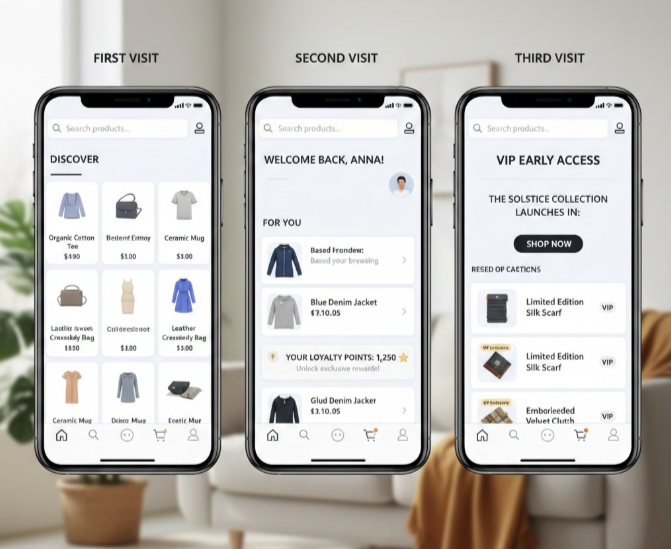
5. Preserve continuity across sessions
On most websites, context disappears between visits. Every session resets, regardless of past behavior, intent, or loyalty. A mobile app closes that gap by preserving continuity across time, sessions, and interactions:
Recently viewed products remain accessible
Purchase cadence informs recommendations
Engagement patterns shape messaging and access
Loyalty status and earned benefits stay visible
Each visit builds on the last instead of restarting from scratch. Customers return to an environment that reflects their history and expectations, making each visit feel familiar and purposeful.
Push notifications reinforce this system. They bring customers back into an environment that already reflects who they are and what matters next.
Push notifications reinforce this system by acting as precise re-entry points. They bring customers back into an environment that already reflects who they are and what matters next.
When having a mobile app doesn’t make sense
A mobile app delivers the most value once retention becomes a deliberate growth lever. For some ecommerce brands, that moment arrives after a few foundational conditions are in place.
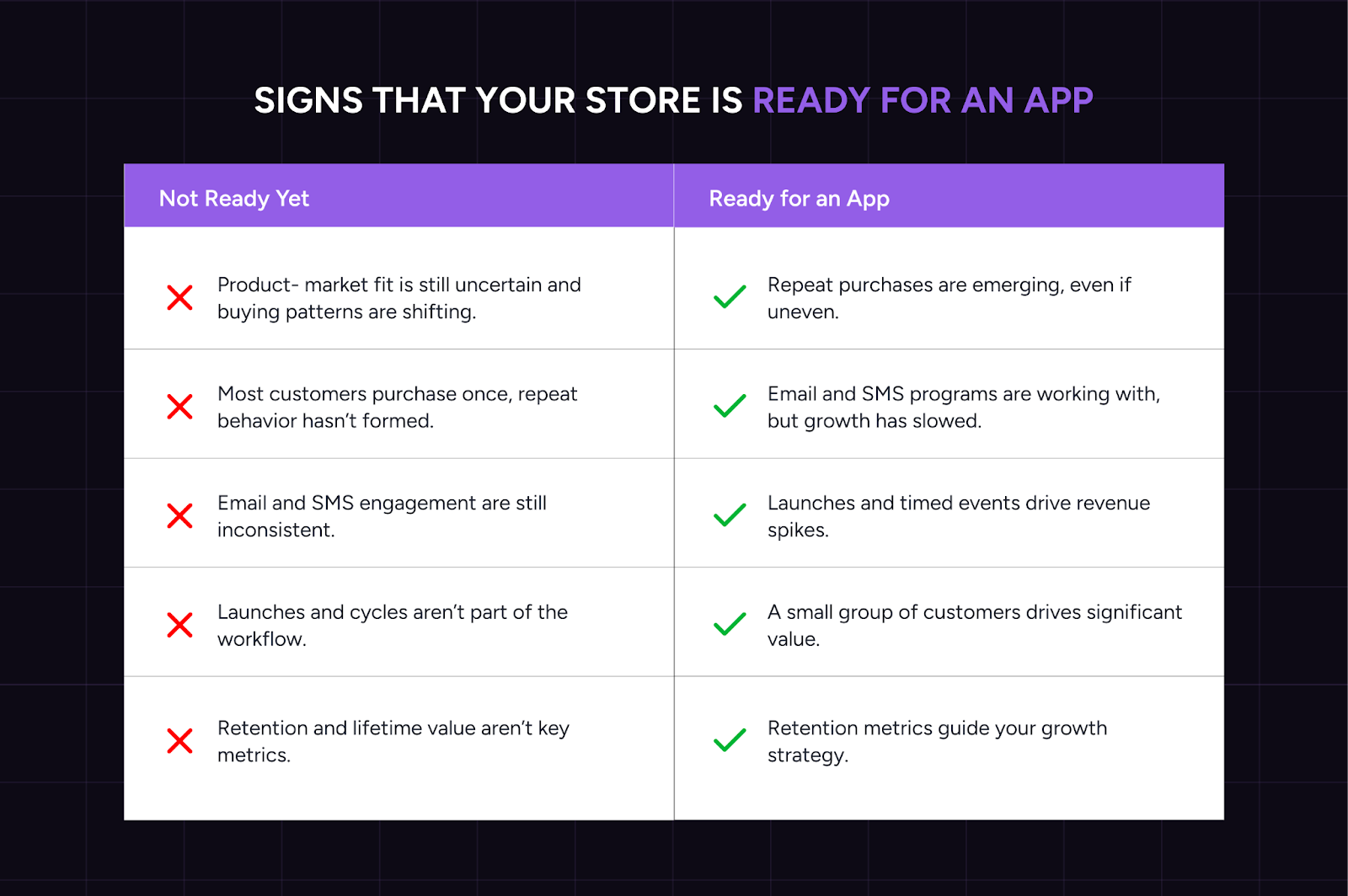
An app may not be the right priority if:
You’re still validating product–market fit, and purchase behaviour is unpredictable.
Most customers purchase once, and there’s no early signal of repeat intent.
Your core owned channels (email and SMS) are underdeveloped or inconsistent.
Launches, replenishment cycles, or time-bound moments aren’t yet part of the operating workflow.
Retention and lifetime value are not yet measured or prioritised internally.
In these cases, your focus should be on stabilising demand and strengthening foundational retention signals first.
A mobile app becomes powerful once repeat behaviour exists and you need infrastructure to scale it, preserving context, differentiating high-value customers, and creating habit-driven engagement over time.
5 signs that your store is ready for an app
A mobile app creates leverage when repeat behaviour already exists and you need infrastructure to scale it. At this stage, the challenge isn’t getting a first purchase. It’s making return behaviour easier, faster, and more predictable.
The following signals indicate that your store has reached the point where it is ready for an app.
1. Repeat purchase patterns are already visible
You can identify customers who return for replenishment, new collections, or seasonal launches.
Some customers buy every 30–60 days, others return around launches, and a smaller group consistently shows up first.
This reveals two clear signals:
Demand exists beyond the first transaction.
Customer intent carries forward across time.
An app anchors that intent to a persistent environment. Instead of relying on customers to rediscover your store, you can give repeat buyers a familiar place that remembers their history and expectations.
2. Your email and SMS programs perform well, but growth has slowed
Your owned channels already work. Campaigns drive revenue, flows convert, and segmentation produces a clear lift. However, growth still feels harder to unlock.
This happens when channels reach saturation.
A mobile app extends your lifecycle system beyond the inbox. Push notifications re-engage customers at high-intent moments, while the app itself becomes a channel that customers voluntarily open.
This reduces reliance on constant messaging and shifts engagement toward habit-driven behaviour.
3. Launches and time-bound moments influence your revenue curve
Your business already runs on moments that create urgency: product drops, restocks, limited collections, early-access windows, or seasonal releases. These events concentrate demand, spike traffic, and attract your most engaged customers.
A mobile app allows you to structure these moments. You can plan access based on specific customer segments, surface launch-specific screens, and guide customers through a controlled flow instead of a single announcement.
Over time, customers learn that the app is where important moments happen, which increases return frequency around each release.
4. A small group of customers contributes a large share of value
You can clearly see a high-value segment emerging. These customers buy more often, spend more per order, and respond strongly to early access or exclusivity.
An app allows you to reflect that value back to them. VIP access, loyalty visibility, and personalised home screens reinforce status. This makes your best customers feel prioritised, deepening attachment.
5. Retention metrics guide your growth decisions
You actively track repeat purchase rate, purchase frequency, and lifetime value alongside acquisition metrics. You plan launches, promotions, and lifecycle programs with long-term value in mind.
At this stage, growth depends on compounding behaviour. A mobile app supports this by carrying customer context forward and allowing each interaction to build on the last.
Over time, this creates momentum. Customers return more often, require less prompting, and deepen their relationship with the brand.
How your mobile app can support retention
A mobile app supports retention differently as your business evolves. Its role expands as repeat behaviour strengthens, customer segments become clearer, and lifecycle complexity increases.
Understanding this progression helps you set realistic expectations and evaluate timing correctly.
Early growth: Reinforce the next purchase and form habits
At this stage, your priority is to move customers to the next purchase. This transition is important because it signals the beginning of repeat behaviour.
A mobile app supports this by keeping your brand at the top of shoppers’ minds between purchases. Customers install the app after checkout to track their order, access app-only incentives, or explore what’s coming next. These touchpoints create familiarity and reduce friction when the next buying moment arrives.
Use the app to:
Recommend recently viewed or complementary products.
Trigger replenishment reminders based on past purchases and purchase timing.
Offer app-exclusive incentives to drive the second purchase.
Preview upcoming drops or restocks.
Each interaction builds recognition and comfort. Over time, customers begin opening the app without a prompt. That shift from prompted engagement to voluntary return is the beginning of habit formation.
Growth stage: Coordinate launches, replenishment, and segmentation
As repeat behaviour increases, retention becomes more nuanced. Customers return for different reasons: some respond to launches, others to replenishment, and others to exclusivity.
A mobile app lets you organise these behaviours into clear segments and deliver experiences that match intent. You can design launch journeys that unfold over time, create replenishment reminders tied to actual purchase cycles, and surface content based on browsing and buying patterns.
At this stage, the app becomes a coordination system. You can:
Offer segment-specific early access to launches.
Send push notifications tied to real purchase timing
Personalise the home screen based on browsing and buying behaviour
Surface dynamic recommendations instead of static merchandising
Customers return because the experience feels relevant, not generic. Engagement deepens, and purchase frequency increases as journeys feel intentional rather than reactive.
Scale stage: Enable VIP access, loyalty visibility, and lifecycle control
At scale, retention depends on how well you recognise and prioritise your most valuable customers.
High-value customers expect clarity. They want to see their status, rewards, and access without friction.
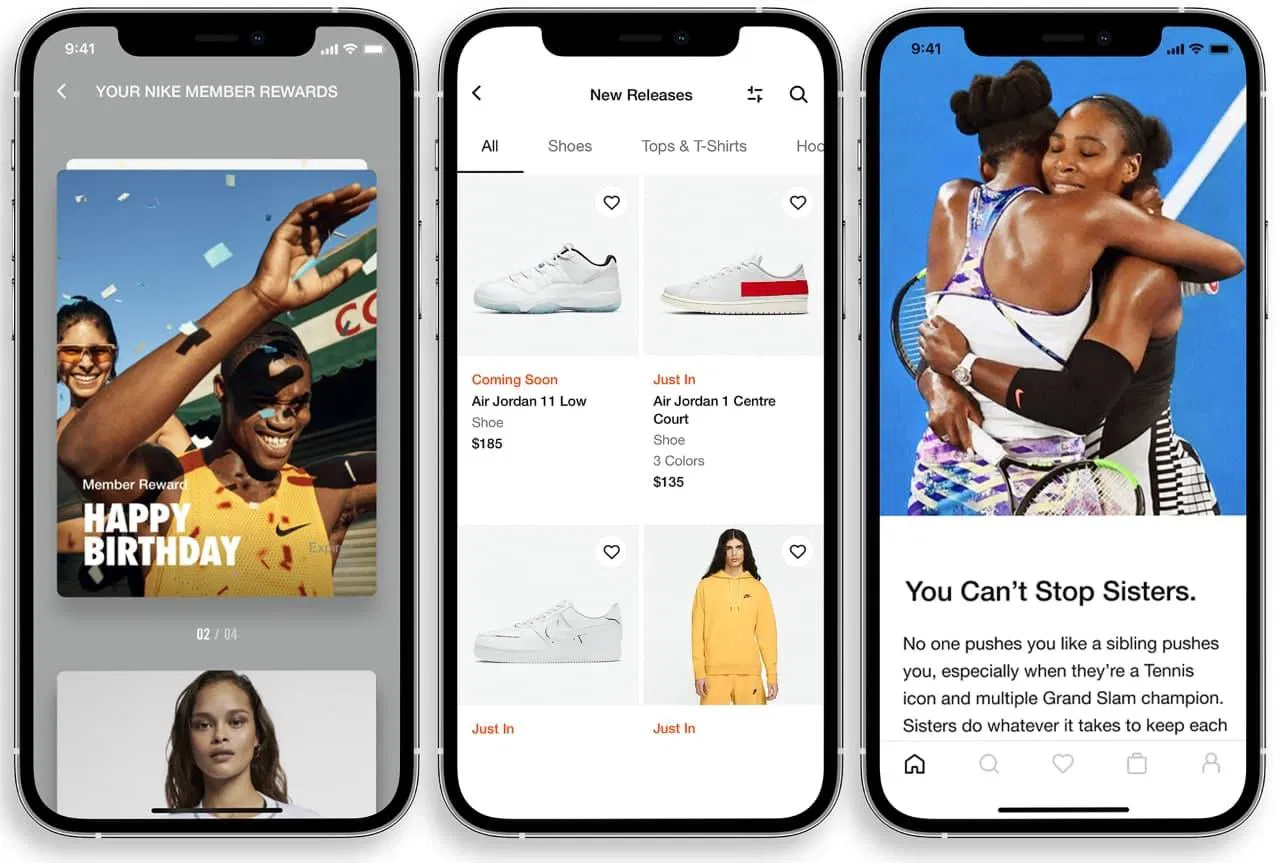
A mobile app makes loyalty visible and actionable. Customers see their status, rewards, and access clearly inside the app. VIP segments get early entry, exclusive content, and personalised experiences that reinforce their importance to the brand.
From an operational perspective, the app gives you lifecycle control. You can orchestrate journeys across launches, rewards, and communication flows without starting over each time. Customer context carries forward, allowing you to refine experiences instead of rebuilding them.
At this stage, the app functions as a retention infrastructure. It supports predictable engagement, strengthens long-term relationships, and allows growth to compound through continuity.
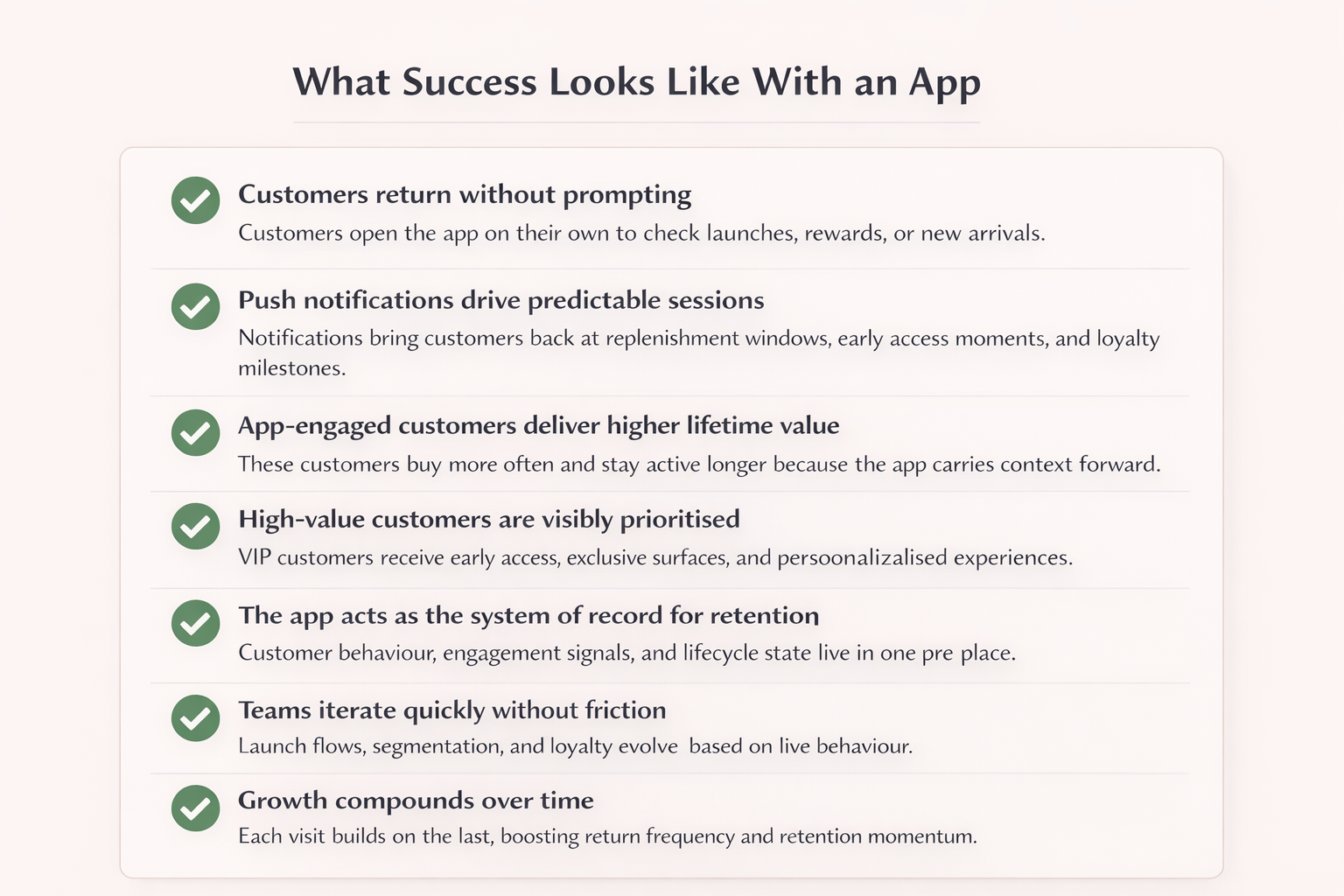
What success looks like with an app
Success shows up in customer behaviour and operational clarity. When a mobile app works, it creates repeatable engagement patterns and gives your team more control over retention. Here’s what that looks like:
Customers return without prompting: Customers open the app on their own to check launches, rewards, or new arrivals. Engagement is no longer dependent on campaigns alone. The app becomes a default destination, not just a notification response.
Push notifications drive predictable sessions: Notifications align with intent and timing, bringing customers back during replenishment windows, early access moments, and loyalty milestones. Return traffic becomes measurable, repeatable, and easier to forecast.
App-engaged customers deliver higher lifetime value: Customers who actively use the app purchase more frequently and stay engaged longer. Their context carries forward (saved preferences, browsing history, loyalty status) which reduces friction and increases conversion over time.
High-value customers are visibly prioritised: VIP customers receive visible benefits inside the app through early access, exclusive surfaces, and personalised experiences that reflect their status and contribution.
The app acts as the system of record for retention: Customer behaviour, session activity, and lifecycle stage are easier to track in one environment. Instead of stitching insights across tools, your team sees how launches, notifications, and loyalty programs influence repeat purchases.
Teams iterate quickly without friction: Launch flows, segmentation logic, and loyalty experiences can be refined based on live behaviour, allowing improvements without operational resets.
Growth compounds over time: Each visit builds on the last. Engagement deepens, return frequency increases, and retention strengthens across cycles.
Drive stronger retention with a mobile app for your ecommerce brand
A mobile app becomes a high-leverage investment when retention sets the pace for growth. At this stage, progress depends on systems that preserve customer context, support repeat behaviour, and deepen relationships across interactions.
It gives you the infrastructure to build retention through a mobile app. Customer behaviour triggers push notifications, routes shoppers into personalised in-app journeys, and supports launches, loyalty visibility, and VIP access without adding operational weight. Each interaction builds on the last, so engagement compounds instead of resetting.
If you’re evaluating whether a mobile app fits your retention strategy, book a demo to see how Superfans.io supports long-term growth.
Thank you! Your submission has been received!
Oops! Something went wrong while submitting the form.
This is some text inside of a div block.
"Looking for creative push notification ideas? Check out our free templates and start customizing!"








.png)
.png)
.png)